Badger: A Woodland Embroidery Design That Feels Wild—but Works Tame
First Impressions: Striking, Not Overworked
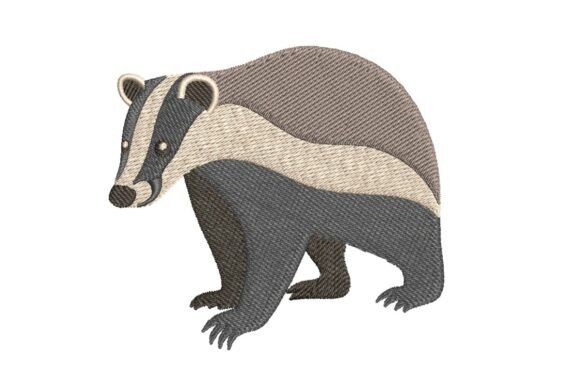
When I opened the Badger embroidery file, what struck me wasn’t just the bold black-and-white stripe across its face—it was how *breathable* the design felt. No overcrowded fill stitches, no frantic detail in the muzzle or ears. The grey fur texture is suggested—not over-rendered—with subtle satin and running stitch layering that gives depth without density. It lands somewhere between illustrative charm and embroidery realism: friendly enough for a baby onesie, grounded enough for a boutique apron. This isn’t a cartoon; it’s a woodland creature with quiet confidence.
Real Project Test: A Linen Tote Bag for a Local Nature Shop
I stitched Badger onto a medium-weight natural linen tote—no lining, no interfacing, just tear-away stabilizer underneath and a light cutaway on top. The result? Clean lines, crisp contrast, and zero puckering around the striped face. The design scaled beautifully at 4.2 inches wide—large enough to read from three feet away, small enough to leave room for a subtle shop logo beneath. Customers paused. They smiled. One asked, “Is that local? Does it live near the creek?” That’s the power of a well-balanced woodland animal: it sparks connection, not just decoration.
Where Badger Shines (and Where It Asks for Care)
Badger thrives where authenticity matters more than flash:
- Custom apparel: On cotton sweatshirts and unbleached tees, its balanced stitch density prevents stiffness—even after washing. Avoid ultra-thin jersey unless you add lightweight fusible + tear-away.
- Embroidered patches: The clean outer shape and minimal interior detail make it ideal for iron-on or sew-on patches. No stray threads in tight corners.
- Baby embroidery: Soft grey tones and rounded contours read as gentle—not sharp or intimidating—on burp cloths, bibs, and crib mobiles.
- Holiday and gift embroidery: Paired with simple green or oatmeal thread, it reads as earthy and timeless—not seasonal, but meaningful. Think handmade Christmas stockings or nursery wall hangings.
- Etsy listings & small shop products: It photographs well flat and in context—especially against raw wood, stone, or neutral fabric backdrops. Buyers associate it with craft integrity, not clipart.
But Badger isn’t bulletproof—and that’s honest design judgment, not a flaw. Use caution on:
- Curved surfaces like caps: The face’s horizontal stripe can distort if hooped too tightly or stitched on low-profile crowns. Test on a cap blank first.
- Dark fabrics: Grey thread may recede. Swap to charcoal or warm taupe for clarity—or go high-contrast with white fill on black denim.
- Textured fabrics (burlap, heavy terry): The fur texture competes visually. Simplify by using fewer tonal variations in thread—or lean into contrast with bold black/white only.
- Small hoop sizes under 4”: The eye detail and stripe separation begin to blur. Stick to 4.5”+ for best legibility.
What Badger Adds to Your Finished Product—Beyond the Stitch
This isn’t just another woodland animal embroidery file. It quietly elevates your handmade product in ways customers feel but rarely name:
- Visual appeal: Its asymmetrical balance—slightly tilted head, one ear higher—creates motion without chaos. It doesn’t sit flat; it *leans in*.
- Stitching clarity: No overlapping satin columns or micro-fill zones. Even on mid-tier machines, edges stay defined and thread transitions are smooth.
- Product value: Because it looks intentional—not generic—it justifies a higher price point on Etsy or at craft fairs. Buyers pay for perceived care, and Badger delivers that.
- Brand consistency: If your shop leans rustic, nature-forward, or slow-made, this design reinforces that voice without needing words.
- Giftability: It reads as thoughtful, not trendy. A Badger-embroidered tea towel feels like a gift you chose—not one you rushed through.
Practical Designer Notes Before You Stitch
Before committing to a client project or production run, do these six things:
- Test Badger on scrap fabric matching your final substrate—especially if using stretchy knits or textured weaves.
- Check thread color contrast in both natural and artificial light. Grey thread on heather grey fabric disappears faster than you’d expect.
- Review stitch density in the fur area—if it feels overly dense for your fabric weight, consider reducing fill % slightly (if your software allows).
- Confirm hoop size compatibility. Does the design fit comfortably within your standard hoop with ½” margin on all sides?
- Inspect small details at 200% zoom: Are the eyes distinct? Does the stripe separation hold up? If not, it may need manual cleanup before stitching.
- Run a black-and-white mockup. If it loses personality in monochrome, reconsider thread choices or simplify background elements.
And always—always—verify licensing terms. If you’re an Etsy seller or small shop owner, confirm whether the Badger embroidery file permits commercial use of finished items *and* resale of the digital embroidery file itself. Ambiguity here risks more than a takedown—it risks your reputation.
Final Thought: Badger Isn’t Just Stitches—It’s a Story Anchor
In a sea of overdesigned woodland motifs, Badger stands out by holding space instead of filling it. It doesn’t shout. It observes. That restraint makes it endlessly adaptable: equally at home on a child’s backpack, a chef’s apron, or a limited-run holiday pillow cover. For embroidery designers and creative entrepreneurs, it’s not just another machine embroidery design—it’s a reliable, resonant piece of visual language. Use it where you want warmth, wit, and quiet authenticity. Just remember: even wild things stitch best with intention.